 WawaCoin
Key Summary
Solana (SOL) is one of the fastest-growing blockchains since its mainnet launch in 2020. As of March 2026, it ranks 4th with an $87 billion market cap, following Bitcoin, Ethereum, and BNB.
Solana's core strengths are speed and cost. It processes 65,000 transactions per second at just $0.00025 per transaction. Compared to Ethereum Layer 1's average gas fees of $2-5, that's over 10,000 times cheaper.
While SOL crashed 90% during the 2022 FTX collapse, it staged a powerful comeback from 2024. The ecosystem grew rapidly as it became the hub for DePIN (Decentralized Physical Infrastructure Networks) and the memecoin craze.
This guide provides in-depth analysis from Solana's technical architecture to its DeFi/NFT ecosystem, investment strategies, and 2026 price outlook. We've organized it so even those new to Crypto Analysis can easily understand.

What is Solana?
Solana Blockchain Overview
Solana is a high-performance Layer 1 blockchain founded by Anatoly Yakovenko in March 2020. A former Qualcomm engineer, Yakovenko developed the Proof of History mechanism to overcome blockchain speed limitations.
Proof of History (PoH) is Solana's unique consensus mechanism. It cryptographically proves the time sequence of transactions, dramatically reducing consensus time between nodes. This results in block generation times of just 400 milliseconds.
Solana Labs and the Solana Foundation lead core development. They raised $314 million from a16z, Polychain Capital and others in 2021, and currently over 1,900 validators operate the network.
Solana is evaluated as an alternative that supports Ethereum's smart contract functionality while solving scalability issues. Those who have read the Ethereum Complete Guide will easily understand the differences between the two blockchains.
| Technology | Role | Advantage vs Ethereum |
|---|---|---|
| Proof of History | Cryptographic time-ordering | 90% consensus time reduction |
| Tower BFT | PoH-based consensus | 400ms block finality |
| Turbine | Block data sharding | Reduced bandwidth usage |
| Gulf Stream | Mempool-less tx forwarding | Minimized latency |
| Sealevel | Parallel smart contracts | Concurrent processing |
| Pipelining | Parallel validation stages | Maximized throughput |
Solana Core Technology Stack
There are 8 core technologies that enable Solana's high performance. Proof of History (PoH) proves time sequences, and Tower BFT handles fast consensus using PoH.
Turbine divides block data into small packets for rapid propagation between nodes. Gulf Stream forwards transactions directly to validators without a mempool, minimizing latency.
Sealevel is Solana's parallel smart contract runtime. Unlike Ethereum which processes transactions sequentially, Solana can process thousands of transactions simultaneously. This is the secret behind 65,000 TPS.
Solana Ecosystem Analysis
Solana's DeFi ecosystem has grown explosively since 2024. As of March 2026, TVL (Total Value Locked) stands at $14.2 billion, ranking 3rd after Ethereum ($58B) and BSC ($4.8B).
Key DEXs (decentralized exchanges) include Jupiter, Raydium, and Orca. Jupiter is an aggregator commanding 80% of Solana DEX volume, with daily trading volume exceeding $2 billion.
In lending protocols, Kamino Finance and Marginfi lead the pack. Kamino is famous for automated liquidity management vaults, recording TVL over $2 billion.
Solana vs Ethereum: Deep Comparison
The biggest difference between Solana and Ethereum is processing speed and cost. Solana handles 65,000 TPS at $0.00025 per transaction, while Ethereum Layer 1 manages 15 TPS with gas fees of $2-20.
However, Ethereum is solving scalability through Layer 2 solutions (Arbitrum, Optimism, Base). Layer 2s achieve thousands of TPS with fees under $0.01.
Block finality time also differs significantly. Solana confirms blocks in 400 milliseconds, while Ethereum takes 12 seconds. This is why Solana is advantageous for real-time trading and gaming.
On the other hand, decentralization favors Ethereum. Ethereum has over 1 million validators, while Solana has about 1,900. High hardware requirements create entry barriers.
From an investment perspective, including both blockchains in your portfolio is reasonable. Solana represents high-growth high-risk, while Ethereum pursues stable growth.
| Metric | Solana | Ethereum L1 | Ethereum L2 |
|---|---|---|---|
| TPS | 65,000 | 15 | 2,000~4,000 |
| Block Time | 400ms | 12 sec | 2 sec |
| Transaction Cost | $0.00025 | $2~20 | $0.01~0.10 |
| Validators | 1,900 | 1,000,000+ | L1 dependent |
| TVL | $14.2B | $58B | $20B+ |
| Daily Transactions | 50M | 1M | 5M |
Solana History and Key Events
Solana has a turbulent history. After its 2020 mainnet launch, it reached an all-time high of $260 during the 2021 bull run, only to crash to $8 following the FTX collapse.
March 2020 saw the mainnet beta launch achieving initial 50,000 TPS. June 2021 brought a record $314 million investment led by a16z, and November 2021 marked the all-time high of $260 with a $77 billion market cap, entering the top 5.
However, September 2022 saw a 17-hour network outage due to bot traffic surge, raising stability concerns. To make matters worse, November 2022 brought the FTX/Alameda collapse, crashing SOL 90% to $8 and threatening survival.
Recovery began in 2024. The explosive growth of memecoins like BONK and WIF catalyzed ecosystem revival. December 2025 saw Jump Crypto's independent Firedancer client deploy to mainnet, improving throughput 10x. As of March 2026, it has surpassed BNB to rank 4th with an $87 billion market cap.
| Period | Event | SOL Price | Impact |
|---|---|---|---|
| 2020.03 | Mainnet Launch | $0.77 | 50,000 TPS achieved |
| 2021.06 | $314M Investment | $40 | a16z, Polychain led |
| 2021.11 | All-Time High | $260 | Entered Top 5 |
| 2022.09 | Network Outage | $32 | 17-hour downtime |
| 2022.11 | FTX Collapse | $8 | 90% crash |
| 2024.03 | Memecoin Craze | $120 | Ecosystem revival |
| 2025.12 | Firedancer Launch | $165 | 10x throughput |
| 2026.03 | Ranked 4th | $187 | $14.2B TVL |
Solana Investment Analysis
Tokenomics Analysis
SOL has no maximum supply cap. However, annual inflation starts at 8% and decreases by 15% each year, converging to 1.5% long-term.
As of March 2026, circulating supply is 464 million SOL. The staking ratio is high at 71.4%. Staked SOL is removed from circulation, reducing selling pressure.
SOL is used for transaction fees and staking rewards. 50% of fees are burned and 50% go to validator rewards. Increased network usage can create deflationary effects.
Solana Strengths
65,000 TPS processing capability Ultra-low cost of $0.00025 per tx 400ms block finality Simple single-layer architecture
Solana Weaknesses
Centralization concerns with 1,900 validators Network outage history (7 times 2021-2022) High node operation costs ($1,000+/month) Scalability limits from state growth
2026 Price Outlook
As of March 2026, SOL trades at $187. That's over 2,200% up from the 2024 low of $8. It's 28% below the all-time high of $260.
From a technical analysis perspective, SOL is moving within an ascending channel. Referring to the RSI Indicator Guide, current RSI at 62 is not yet overbought. There's room for further upside.
Bull scenario: $350-$400 by end of 2026 is possible. Conditions include Firedancer stabilization, ETF approval expectations, and continued Bitcoin bull run.
Bear scenario: Correction to $100-$130 is expected. This scenario could unfold with macro deterioration, overwhelming Ethereum L2 adoption, or network issues recurring.
Bull Scenario — 45% Probability
2026 year-end target: $350~$400 Conditions: Firedancer stabilization, SOL ETF expectations Catalysts: Bitcoin bull run continues, DePIN ecosystem growth TVL target: Break $20B
Bear Scenario — 30% Probability
2026 year-end target: $100~$130 Conditions: Macro environment worsens, rate hikes resume Risks: Network outage recurrence, regulatory tightening Response: DCA entry below $120
Neutral Scenario — 25% Probability
In the neutral scenario, SOL ranges between $150-$220. The situation maintains current levels without special catalysts. Buy at range lows and partial profit-taking at highs would be a valid strategy.
Long-term outlook (2027-2028) suggests cycle peak of $500-$700 is possible. Conditions include crypto mass adoption and institutional adoption expansion. However, Ethereum L2 competition intensification remains a risk requiring continuous monitoring.
WawaCoin Outlook
Bullish Factors
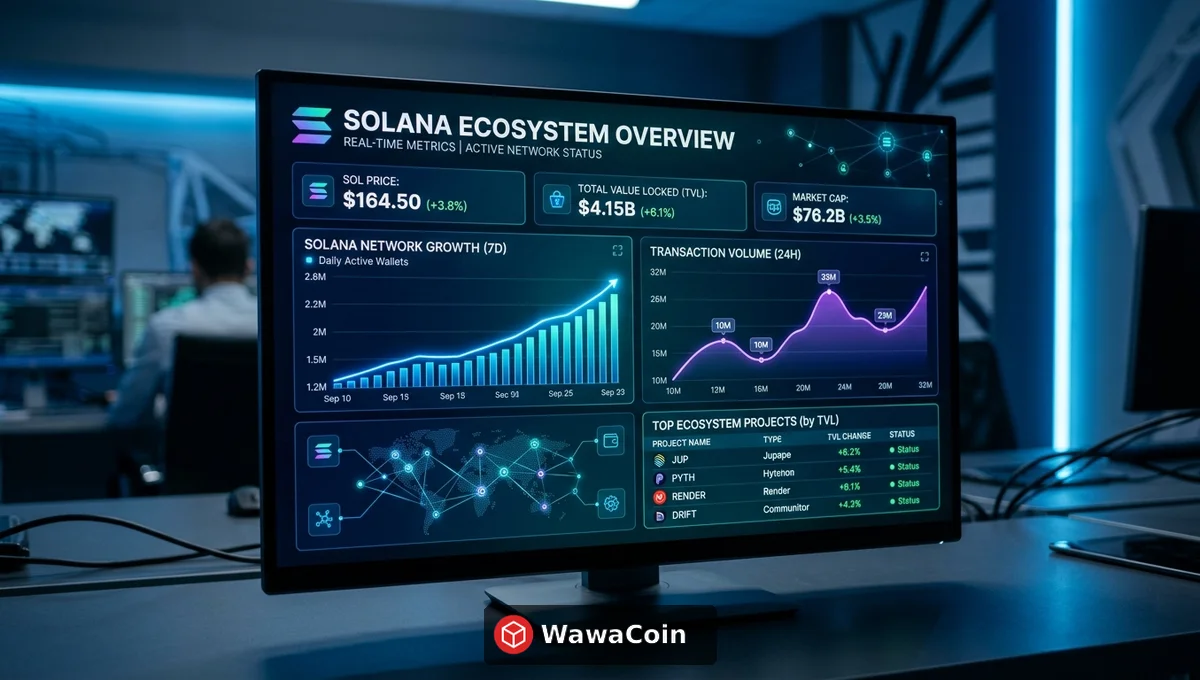
Continued growth in DePIN and memecoin ecosystem 10x throughput improvement with Firedancer TVL at $14.2B maintaining 3rd place 2.8M daily active addresses showing real usage growth
Bearish Factors
Centralization concerns with 1,900 validators 7 past network outage incidents Intensifying Ethereum L2 competition Risk-off sentiment in macro downturns
Neutral Factors
$150~$220 range-bound possibility SOL ETF approval uncertainty Bitcoin correlation at 0.85 maintained
Overall, Solana shows strong growth momentum on both technical and ecosystem fronts. The resilience of recovering from $8 to $187, a 2,200% gain after the worst crisis of FTX collapse, proves the community's strength.
From an investment perspective, Solana is an alternative Layer 1 asset to consider after Bitcoin and Ethereum. Allocating 10-20% of your portfolio and managing risk through DCA strategy is reasonable.
Key monitoring metrics are TVL, daily active addresses, and developer count. Breaking $20B TVL and maintaining 3M+ daily addresses would be bullish signals. Conversely, consider reducing positions if network outages occur or TVL drops sharply.
You can purchase SOL at Top Exchanges. Major exchanges like Binance, Coinbase, and Kraken all support SOL/USD and SOL/USDT pairs.
Investor Checklist
Based on this analysis, here are essential items to check before investment decisions. Clearly establish your entry timing and risk management strategy.
Entry Strategy
At current price ($187), consider 1st entry at 10% correction ($168), 2nd entry at 20% correction ($150) to lower average cost. Active buying below $130 can be considered.
Utilize Staking
Long-term investors should consider staking for 6-8% annual rewards. We recommend Marinade Finance (mSOL) or Jito (jitoSOL). Additional DeFi yields are also possible.
Set Stop-Loss
Mechanical stop-loss at -25~30% loss from entry is recommended. Emotional additional buying can magnify losses.
Position Sizing
Maintain SOL allocation within 10-20% of your total crypto portfolio. Concentration in a single asset is dangerous.
Network Monitoring
Check Solana status page (status.solana.com) weekly. If network outage history recurs, immediate response is needed.
Track Ecosystem Metrics
Monitor TVL, daily transactions, and developer activity. Free data available at DeFiLlama, Messari, and Token Terminal.
FAQ
Is Solana an Ethereum killer?
Solana is a blockchain with a different design philosophy than Ethereum. It leads in speed and cost, but Ethereum has the edge in decentralization and proven security. It's more accurate to view it as an "alternative" or "complement" rather than a "killer." Both chains will likely coexist serving different use cases.
Could Solana network go down again?
The possibility exists but has significantly decreased. Multiple improvements have been made since 2022, and Firedancer's 2025 launch secured client diversity. With two independent clients (Agave, Firedancer), single points of failure have been eliminated. However, no blockchain can guarantee complete perfection.
What is SOL staking yield?
As of March 2026, annual yield is around 6-8%. Staking through Jito can reach up to 8.5% including MEV rewards. Using liquid staking (mSOL, jitoSOL), you can earn staking rewards while also pursuing additional DeFi yields.
Will a Solana ETF be approved?
As of March 2026, no Solana spot ETF has been approved. SOL ETF applications were filed after Bitcoin and Ethereum ETFs, but the SEC has not yet decided. With improved crypto regulatory environment, approval could be possible after 2027.
Should I invest in Solana or Ethereum?
It depends on your risk preference. If you want stable growth, Ethereum; if you can tolerate high-growth high-risk, Solana is suitable. From a diversification perspective, including both assets in your portfolio is also a good strategy. We recommend a ratio of about 60% Ethereum, 40% Solana.
Conclusion
Solana (SOL) has established itself as core cryptocurrency market infrastructure in 2026. With technical strengths of 65,000 TPS and $0.00025 per transaction, it has become the hub for DeFi, NFT, and memecoin ecosystems.
Overcoming the worst crisis of the 2022 FTX collapse and rising 2,200% from $8 to $187 demonstrates Solana community's resilience. Network stability has also greatly improved with Firedancer launch.
From an investment perspective, Solana is a high-risk, high-reward asset. The range is wide with $350-$400 in bull scenario and $100-$130 in bear scenario. DCA and clear stop-loss settings are essential.
Key Summary: - Market cap $87B ranking 4th, TVL $14.2B ranking 3rd - 65,000 TPS, ultra-low cost $0.00025 per tx - Stability and throughput improved with Firedancer - Bull scenario $350-$400, Bear scenario $100-$130 - Portfolio allocation 10-20%, DCA strategy recommended
Solana plays an important role in the blockchain ecosystem as both an alternative and complement to Ethereum. Considering its technical advantages and active ecosystem, allocating 10-20% to a long-term portfolio is a reasonable strategy.
For more Crypto Analysis, check the crypto analysis page.