 WawaCoin
Key Summary
The MVRV ratio (Market Value to Realized Value) is one of the most reliable cycle indicators in on-chain analysis. It divides Bitcoin's market cap by its realized cap, showing whether the market is overall in profit or loss.
Since 2010, every Bitcoin cycle has shown that MVRV above 3.7 signals a top, while below 1.0 signals a bottom. The December 2017 peak (MVRV 4.85), April 2021 peak (3.96), and November 2022 bottom (0.76) all followed this pattern.
The current MVRV ratio stands at 2.85, before entering the overheated zone (3.7+). Historically, the 2.5~3.5 MVRV range indicates an ongoing uptrend but requires caution.
This analysis covers MVRV's definition and calculation, historical pattern analysis, Z-Score variations, and practical investment strategies. Combined with Bitcoin Whale Wallet Tracking, you can improve market prediction accuracy.
MVRV Ratio Definition and Principles
Difference Between Market Cap and Realized Cap
Market Cap is calculated as current Bitcoin price × circulating supply. As of March 2026, with Bitcoin at $75,000 and 19.7 million BTC in circulation, market cap is approximately $1.4775 trillion.
Realized Cap values each Bitcoin at the price when it last moved. For example, 1 BTC that last moved in 2020 at $10,000 is valued at $10,000 regardless of current $75,000 price. The sum of all BTC valued this way equals realized cap.
Realized cap can be interpreted as the network's 'total cost basis.' Current realized cap is approximately $518 billion, meaning the average acquisition price of all Bitcoin holders is about $26,300.
MVRV = Market Cap ÷ Realized Cap, so the current value is $1.4775T ÷ $0.518T = 2.85. This means that on average, all Bitcoin holders are sitting on 185% unrealized profit.
| Category | Market Cap | Realized Cap |
|---|---|---|
| Calculation | Current Price × Supply | Sum of Last-Moved Prices |
| Meaning | Current Market Value | Network Total Cost Basis |
| Volatility | High | Low |
| March 2026 | $1.48T | $0.52T |
| Avg. Cost Basis | $75,000 (Current) | $26,300 |
| Usage | General Size Measure | On-Chain Analysis Baseline |
MVRV Calculation Formula and Interpretation
MVRV calculation is simple but interpretation is key. MVRV = Market Cap ÷ Realized Cap, and market state is judged by the result.
MVRV > 1 means holders are on average in profit, MVRV < 1 means in loss. Higher values indicate larger unrealized profits, lower values indicate larger unrealized losses. When profits maximize, selling pressure increases; when losses maximize, it becomes a buying opportunity.
Historically, MVRV above 3.7 has been valid for top selling, below 1.0 for bottom buying. However, in extreme bull markets, MVRV has risen to 4.0~5.0, so zone-based responses are more reasonable than single thresholds.
MVRV Historical Pattern Analysis
2013~2017 Cycle
When Bitcoin first broke $1,000 in December 2013, MVRV rose to 5.2. It then dropped 85% over a year, with MVRV falling to 0.85. Most investors entered loss territory at that time.
At the December 2017 peak of $19,700, MVRV recorded 4.85. Though lower than the 2013 peak (5.2), it was still an extreme overheated signal. MVRV then fell to 0.69 after an 84% drop over a year.
Notably, peak MVRV has been trending lower: 5.2 (2013) → 4.85 (2017) → 3.96 (2021). As the market matures, extreme overheating levels are moderating. For more in-depth Crypto Analysis, please refer to our guides.
2013 Cycle Peak
MVRV: 5.2 (Dec 2013)
Bitcoin Price: $1,147
Subsequent Drop: -85% (to $172)
Bottom MVRV: 0.85 (Jan 2015)
2017 Cycle Peak
MVRV: 4.85 (Dec 2017)
Bitcoin Price: $19,700
Subsequent Drop: -84% (to $3,200)
Bottom MVRV: 0.69 (Dec 2018)
2013~2017 Lessons
MVRV 4.5+ = Extreme Overheating
Bottom MVRV 0.7~0.9 = Buy Opportunity
Cycle Peak MVRV Trending Lower
2020~2024 Cycle
During the March 2020 COVID crash, MVRV dropped to 0.85. This was a bottom-buying signal, and Bitcoin subsequently rose 1,280% from $5,000 to $69,000. MVRV reached 3.96 in April 2021, forming the first peak.
Interestingly, at the November 2021 $69,000 top, MVRV was 3.12, lower than the April peak (3.96). This was because realized cap increased significantly during the double top formation. Many investors took profits and re-entered between April and November, raising the average cost basis.
During the November 2022 FTX collapse, MVRV dropped to 0.76. This was the lowest since the 2018 bottom (0.69), representing a historic buying zone. Bitcoin has since risen 384% from $15,500 to the current $75,000.
| Date | MVRV | BTC Price | Event |
|---|---|---|---|
| Mar 2020 | 0.85 | $5,000 | COVID Crash (Bottom) |
| Apr 2021 | 3.96 | $64,800 | 1st Cycle Peak |
| Jul 2021 | 1.68 | $29,000 | Mid-Cycle Correction |
| Nov 2021 | 3.12 | $69,000 | 2nd Cycle Peak |
| Jun 2022 | 0.95 | $17,600 | Luna/3AC Collapse |
| Nov 2022 | 0.76 | $15,500 | FTX Collapse (Bottom) |
| Mar 2024 | 2.62 | $73,000 | Pre-Halving Peak |
| Mar 2026 | 2.85 | $75,000 | Current |
Cycle Peak MVRV Timeline
December 2013
MVRV 5.2 — Bitcoin $1,147, first $1,000 break. 85% drop followed
December 2017
MVRV 4.85 — Bitcoin $19,700 peak. ICO bubble climax
April 2021
MVRV 3.96 — Bitcoin $64,800 first peak. Institutional entry begins
March 2026 (Current)
MVRV 2.85 — Bitcoin $75,000. Post-ETF market maturation
MVRV Z-Score Deep Dive
Meaning of Z-Score Transformation
MVRV Z-Score is a normalized version of MVRV. The formula is (Market Cap - Realized Cap) ÷ Market Cap Standard Deviation, measuring the deviation of current MVRV from historical average.
Z-Score's advantage is clearer identification of extreme zones. Z-Score above 7 indicates extreme overheating, below 0 indicates extreme undervaluation. The 2017 peak Z-Score was 9.5, the 2021 peak was 7.2.
Current MVRV Z-Score is 3.8, in the neutral to slightly overvalued zone. Historically, price continued rising in the Z-Score 4~6 range, so it's too early to interpret this as a top signal. Considering institutional inflows discussed in Bitcoin ETF Guide, there's room for further upside.
Undervalued Zone (Z < 0.5)
Signal: Strong Buy
Historical Accuracy: 95%+ bottom hit rate
Recent Example: Nov 2022 (Z = -0.3)
Action: Aggressive DCA
Fair Value Zone (0.5 < Z < 4)
Signal: Neutral~Hold
Historical Accuracy: 75% uptrend continuation
Current Position: Z = 3.8
Action: Maintain Position
Overheated Zone (Z > 6)
Signal: Strong Sell
Historical Accuracy: 90%+ top hit rate
Recent Example: Apr 2021 (Z = 7.2)
Action: Scale Out
Z-Score Limitations and Supplements
MVRV Z-Score has limitations. First, as the market matures, extreme Z-Score occurrences are decreasing. Peak Z-Score has declined from 9.5 (2017) to 7.2 (2021).
Second, Z-Score is a lagging indicator. When it reaches extreme values, price has already moved significantly. Cross-verification with other indicators is essential for leading signals.
Third, Z-Score is less useful in prolonged sideways markets. When there's no clear direction like in 2019, Z-Score stays in neutral zones without giving clear signals.
For supplementation, analysis with other on-chain indicators like SOPR, NUPL, and exchange reserves is recommended. Technical analysis like RSI Indicator Guide can also improve accuracy.
2026 Current MVRV Analysis
Deep Interpretation of Current Values
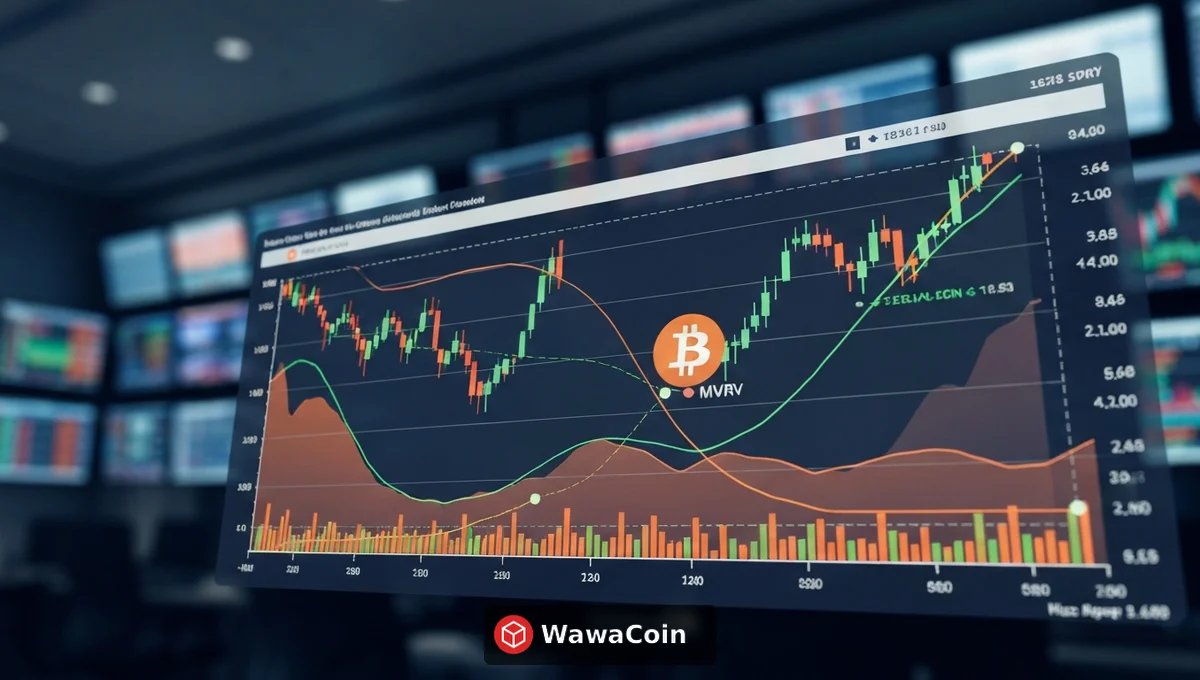
As of March 25, 2026, the MVRV ratio is 2.85. This is in the neutral to slightly overvalued zone, with about 30% headroom to the overheated threshold (3.7).
Realized cap is at $518 billion, an all-time high. This means many investors entered at relatively high prices, and the network's cost basis has risen.
MVRV 2.85 means the average holder purchased at 65% of the current price ($75,000 ÷ 2.85 ≈ $26,300). This average cost basis can serve as strong support.
Bullish Factors
• MVRV 2.85 hasn't entered overheated zone (3.7+)
• Realized cap at ATH (cost basis rising)
• Long-term holder supply shortage slowing realized cap rise
• Continued institutional inflows (ETF net inflows)
Bearish Factors
• MVRV 2.5~3.5 historically high volatility zone
• STH-MVRV at 1.15 creating profit-taking pressure
• Rising leverage ratios increase liquidation risk
• Macro uncertainty (rates, geopolitics)
Neutral Factors
• Cycle peak MVRV declining (5.2 → 4.85 → 3.96)
• Current cycle peak may be 3.0~3.5
• Sideways would raise realized cap, naturally lowering MVRV
Scenario-Based Outlook
Bull Scenario (55% probability): MVRV could rise to 3.5~4.0. Bitcoin price would reach $90,000~$110,000. Recommend scaling out above MVRV 3.7.
Neutral Scenario (30% probability): MVRV ranges 2.5~3.0. Bitcoin trades in $65,000~$85,000 box, with MVRV naturally stabilizing as realized cap rises.
Bear Scenario (15% probability): MVRV drops to 1.5~2.0. This implies Bitcoin correction to $40,000~$50,000, presenting an aggressive DCA zone. Use waiting capital as explained in Stablecoin Guide for bottom-buying strategy.
| Scenario | Probability | MVRV Range | BTC Price Range | Strategy |
|---|---|---|---|---|
| Bull | 55% | 3.5~4.0 | $90K~$110K | Scale out at MVRV 3.7+ |
| Neutral | 30% | 2.5~3.0 | $65K~$85K | Hold position |
| Bear | 15% | 1.5~2.0 | $40K~$50K | DCA buying |
| Extreme Bear | 5% | Below 1.0 | $25K~$35K | Aggressive buy |
MVRV Investment Strategies
Zone-Based Position Strategy
MVRV-based investment strategy is about differentiated zone responses. Zone-based strategies are more effective for returns and risk management than single thresholds.
MVRV Below 1.0: Historic bottom zone. Recommend aggressive DCA, expanding portfolio allocation to maximum (5~10%). Investors who bought at MVRV 0.76 in November 2022 gained 384%.
MVRV 1.0~2.5: Fair investment zone. Maintain DCA strategy, add on dips. Hold existing positions but avoid chasing.
MVRV 2.5~3.5: Caution zone. Avoid new buys, hold existing. Prepare to take profits when 3.5 is breached.
MVRV 3.5+: Overheated zone. Execute scaled profit-taking (30~50%), additional exits above 3.7. Increase cash or stablecoin allocation to prepare for next cycle bottom.
Undervalued Zone (MVRV < 1.0)
Position: Aggressive Buy
Portfolio Weight: 5~10%
DCA Splits: 3~5x
Stop-Loss: None (Long-term Hold)
Fair Value Zone (1.0~2.5)
Position: Hold + DCA
Portfolio Weight: 3~5%
DCA: On Dips Only
Stop-Loss: -30% (Extreme Case)
Caution Zone (2.5~3.5)
Position: Hold
New Buys: Avoid
Profit-Taking Prep: At 3.5 Break
Monitoring: 2x Weekly
Overheated Zone (3.5+)
Position: Scale Out
1st Exit: 3.5 (30%)
2nd Exit: 3.7 (30%)
3rd Exit: 4.0 (40%)
Cross-Verification with Other On-Chain Metrics
Using MVRV alone is less effective than cross-verification with other indicators. Key supplementary metrics include SOPR, NUPL, and exchange reserves.
SOPR (Spent Output Profit Ratio) measures the average profit ratio of coins moved that day. SOPR > 1 means profit-taking dominates, < 1 means loss-cutting dominates. MVRV overheated + SOPR > 1.05 is a strong sell signal.
NUPL (Net Unrealized Profit/Loss) measures the ratio of total unrealized P/L. NUPL > 75% indicates extreme greed, < 0% extreme fear. Signal reliability increases when MVRV and NUPL align.
Exchange Reserves are a leading indicator of selling pressure. MVRV overheated + rising exchange inflows signals imminent correction.
| Combo Signal | MVRV | Supporting Metric | Strength | Action |
|---|---|---|---|---|
| Strong Buy | < 1.0 | SOPR < 0.95, NUPL < 0 | ★★★★★ | Aggressive Buy |
| Weak Buy | 1.0~1.5 | SOPR ≈ 1, NUPL 0~25% | ★★★☆☆ | DCA |
| Neutral | 1.5~2.5 | SOPR 1.0~1.03 | ★★☆☆☆ | Hold |
| Weak Sell | 2.5~3.5 | SOPR 1.03~1.05 | ★★★☆☆ | Prep Exit |
| Strong Sell | > 3.5 | SOPR > 1.05, NUPL > 75% | ★★★★★ | Scale Out |

Practical Investment Checklist
Key items to check before making MVRV-based investment decisions. Use this checklist to eliminate emotional judgment and make data-driven decisions.
Check Current MVRV
Check latest MVRV on Glassnode, CryptoQuant, etc. Use 7-day average instead of daily to reduce noise. Determine current zone (undervalued/fair/overheated) then decide strategy.
Cross-Verify with Other Metrics
Check SOPR, NUPL, exchange reserves together. Signal reliability is higher when 2+ indicators point the same direction. Be cautious when indicators conflict.
Position Sizing
Follow recommended MVRV zone allocations (1~10%). Limit new buys in overheated zone to under 1%. Avoid all-in even in undervalued zone.
Execute Scaled Trades
Split both buys and sells into 3~5 tranches. Execute at preset ratios when targets are hit. Stay mechanical and avoid emotional decisions.
Record and Review
Record MVRV, price, and reasoning at each trade. Review quarterly to improve strategy. Analyzing success/failure patterns improves skills.
Risk Management
Set maximum loss limit (-30%). Ensure you don't lose entire capital in extreme scenarios. Use leverage only limitedly in MVRV undervalued zones.
MVRV Limitations and Cautions
Frequently Asked Questions
What exactly is the MVRV ratio?
MVRV (Market Value to Realized Value) ratio is Bitcoin's market cap divided by realized cap. Market cap is current price × supply, realized cap is the sum of prices when each BTC last moved. MVRV > 1 means holders are on average in profit, < 1 means in loss.
Where can I check MVRV?
You can check on on-chain analytics platforms like Glassnode, CryptoQuant, and Blockchain.com. Glassnode provides basic MVRV with free accounts, while Z-Score and detailed analysis require paid plans.
What does current MVRV 2.85 mean?
MVRV 2.85 means the average Bitcoin holder is sitting on 185% unrealized profit. It's in the neutral to slightly overvalued zone, with room before the overheated threshold (3.7). However, the 2.5~3.5 zone can see increased volatility, so risk management is needed.
Can I make investment decisions based on MVRV alone?
Using supporting metrics like SOPR, NUPL, and exchange reserves together is recommended over standalone use. MVRV is useful for cycle judgment but difficult for short-term prediction and has lagging characteristics.
Could this cycle's peak MVRV be lower than before?
Yes, it's likely. Cycle peak MVRV has been trending down: 5.2 (2013) → 4.85 (2017) → 3.96 (2021). As the market matures with more institutional investors, extreme overheating is moderating. This cycle's peak MVRV may be in the 3.0~3.5 range.
What's the difference between MVRV Z-Score and regular MVRV?
Regular MVRV is the absolute value of Market Cap ÷ Realized Cap, while Z-Score normalizes this by historical mean and standard deviation. Z-Score more clearly distinguishes extreme zones, with below 0 = strong buy, above 7 = strong sell.
Can MVRV be applied to altcoins?
Theoretically possible but less useful. Bitcoin has 14 years of data with verified patterns, while most altcoins have short histories and complex supply calculations. Ethereum MVRV is available on Glassnode, but patterns aren't as reliable as Bitcoin's.
Does MVRV dropping mean price will drop too?
No. MVRV = price ÷ average cost basis, so even if price stays flat, active coin movement raises realized cap and lowers MVRV. Between April~November 2021, price was similar but MVRV dropped from 3.96 to 3.12. MVRV decline doesn't necessarily mean price decline.
Conclusion
The MVRV ratio is one of the most reliable on-chain metrics for identifying overheated and undervalued periods in Bitcoin cycles. It has accurately captured all major tops (MVRV 3.7+) and bottoms (MVRV 1.0-) since 2010.
Current MVRV 2.85 is in the neutral to slightly overvalued zone, with room before the overheated threshold (3.7). Given the declining trend in cycle peak MVRV (5.2 → 4.85 → 3.96), this cycle may top at 3.0~3.5.
Core Investment Principles:
• MVRV < 1.0: Aggressive Buy Zone
• MVRV 1.0~2.5: Fair Investment Zone (DCA)
• MVRV 2.5~3.5: Caution Zone (Avoid New Buys)
• MVRV > 3.5: Overheated Zone (Scale Out)
Cross-verifying MVRV with SOPR, NUPL, and exchange reserves increases signal reliability. However, MVRV isn't magic—use it as a probabilistic tool considering its lagging nature and cycle variations.
Eliminating emotion and making data-driven decisions is key to long-term Bitcoin investment success. MVRV will be one of the most powerful compasses on that journey.